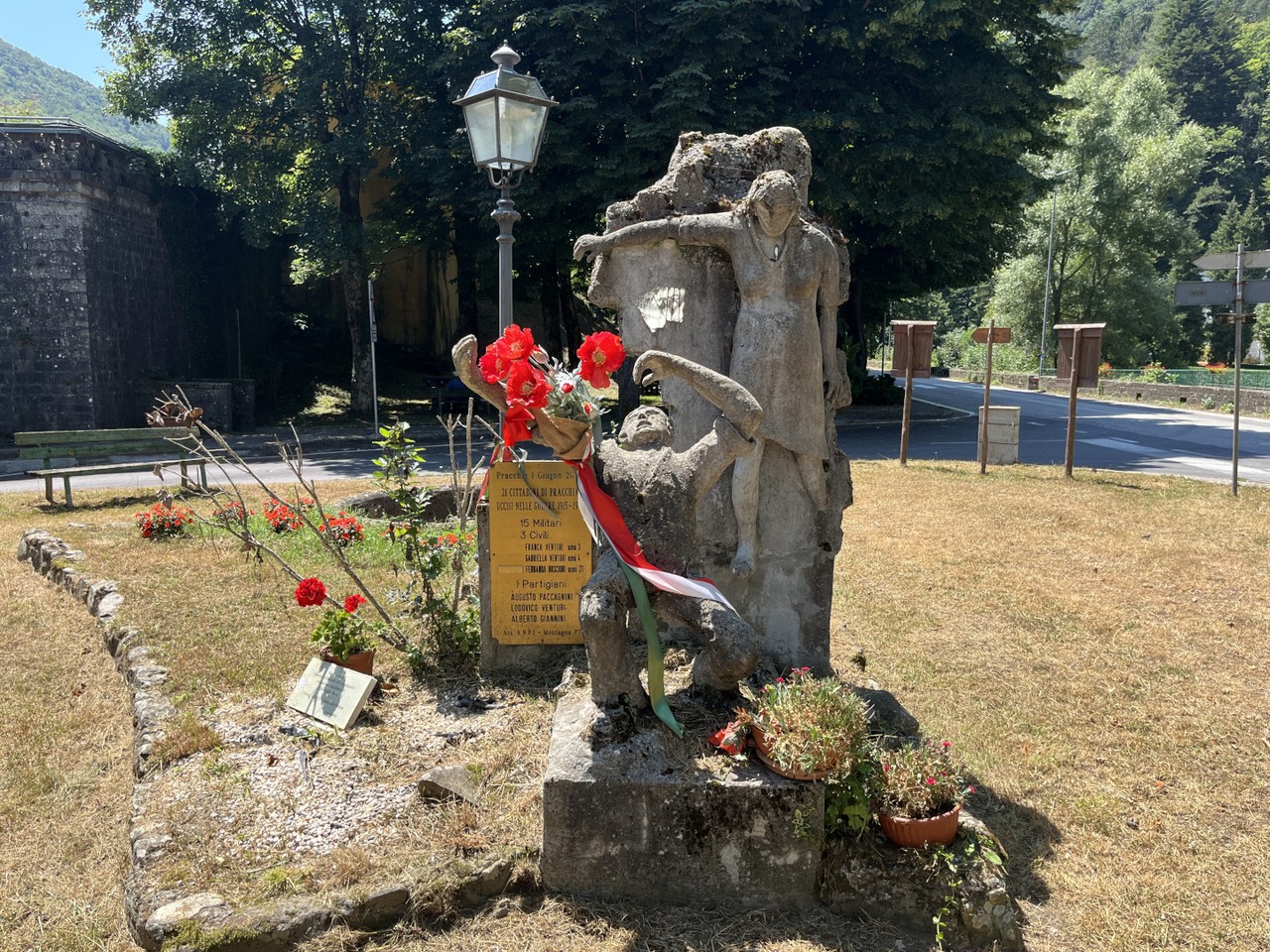
Walking along the right bank of the Reno River, on a path of pilgrims and singer-songwriters, the route runs above the historic Porrettana Railway along its entire length, up to the border with Emilia. These are places where the proximity of the Gothic Line has left traces and memories in every village, today immersed in silence among the forests.
From Pracchia, the route follows CAI trail 177, not far from the bridge over the Reno River, and after a short stretch reaches Frassignoni, a small hamlet made up of scattered clusters of houses. Overlooked by the summit of Monte Pidocchina (1,296 m), Frassignoni faces the pyramid-shaped peak of Monte Cocomero and its wild slopes. In this area, the memory of a legendary beech forest still lingers: tradition tells of an ancient woodland so dense and vast that even the wind could not extinguish a candle lit beneath its canopy.
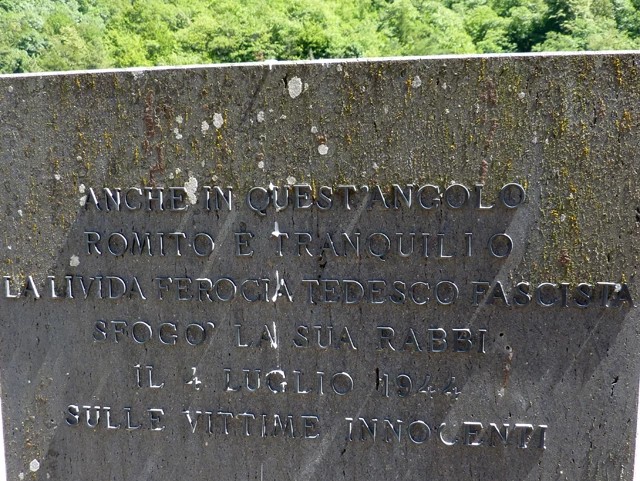
Continuing eastward, the trail passes the locality of Biagioni, a place marked by a tragic massacre that occurred on July 4, 1944, on the church steps — a nearly unique case carried out exclusively by Fascist militias and the III Freiwilligen Battaillon Italien, composed of Italian soldiers who had enlisted in the German police forces.
The route climbs further toward the ridge and, after passing the Croce dei Prati, joins CAI trail 163 leading to Pòsola. The village lies on a plateau at 942 meters above sea level, near the watershed dividing the Reno valley from that of the Western Limentra, and is dominated by the summit of Crocione with its large metal cross. According to tradition, the name derives from an old staging post for travelers and merchants, and several restored buildings preserve remarkable architectural details: stone masks, ancient dates, inscribed lintels with crosses, solar symbols, and depictions of masonry tools used by stonemasons.
Descending toward the Limentra valley, the path intersects the Castle of Sambuca Pistoiese, an ancient fortified village in a dominant position. This is also where Selvaggia dei Vergiolesi died, the woman celebrated by the poet Cino da Pistoia, who had taken refuge here with her family after being exiled from Pistoia. From here the journey follows the Via Francesca della Sambuca, which connects Bologna and Pistoia along the Apennine ridges. The area of Sambuca Pistoiese was heavily affected during the Second World War by raids, deportations, massacres, and anti-partisan operations carried out by German troops in cooperation with those of the Italian Social Republic, and today numerous memorial sites recall these events.
The next stop is Pàvana, one of the most culturally evocative villages in the area, closely linked to the singer-songwriter Francesco Guccini, who grew up here as a child and often referenced it in his works. The well-preserved Chicon mill stands as a central element of the family saga described in Cròniche Epifaniche, a valuable testimony of the village’s dialect and culture in the post-war years. Under the village arcades, a large fresco by Paolo Maiani, created for Pàvana’s thousand-year anniversary, illustrates its long history in visual form.
The route then follows the Reno River down to Porretta Terme, a historic spa town at the foot of the Apennines. A medieval legend tells of a sick ox left to roam freely by its owner, which, after drinking from the waters of Monte Sassocardo, returned completely healed — an episode that gave rise to the reputation of the healing springs. The thermal baths were already known in Roman times, and during the Renaissance they hosted figures such as Lorenzo de' Medici, the Gonzaga cardinal, and the painter Andrea Mantegna. In 1864, the arrival of the railway transformed Porretta into a lively and popular spa destination on the border between Tuscany and Emilia.