Crossing the border between Lucca and Pistoia, among medieval towers and mountain legends, this stage offers long solitary stretches immersed in chestnut and oak forests, an invitation to let the memories encountered along the journey slowly settle and resonate.
The trail begins by leaving Vico Pancellorum, a locality in the municipality of Bagni di Lucca, heading toward the border between the two provinces — Lucca and Pistoia — to discover fascinating geological features immersed in an environment that, at times, recalls Mediterranean scrubland. A comfortable recently restored mule track leads to the Grotte, a curious shelter carved into the rock face that drops perpendicularly beside the path.
Alternating between beech and oak forests, the route follows the Strada delle Polle, so named for the abundance of small springs and water sources encountered along the way. As the trail progresses, increasingly wide views open to the east over the Pistoia plain, while the sound of flowing streams accompanies every step. After a long stretch fully immersed in nature, passing the Renicci saddle and the Canali area, the path reaches the Sasso delle Streghe, a place considered magical where local legend says witches once gathered around the imposing boulder to cast spells against the convent below.
The descent leads to Popiglio, a village of ancient origins positioned in a strategic location that for centuries made it one of the most contested places in the Tuscan Apennines. Already a Roman settlement, the fortress became a defensive stronghold on the border with the Lucchese state. Above the village stand the Towers of Popiglio, the last remains of the medieval Rocca Securana, whose entrances could only be accessed via a ladder that could be withdrawn in case of attack. In the center of the village, the Parish Church of Santa Maria Assunta, founded in 1271 in late Romanesque style, preserves valuable altars, paintings, and wooden furnishings that form part of the Sacred Art section of the Mountain of Pistoia Ecomuseum.
Descending about one kilometer toward the valley floor, the trail reaches another medieval masterpiece: the Ponte di Castruccio, also known as the Campanelle Bridge. Originally Romanesque and later rebuilt by Castruccio Castracani in the 14th century, it is distinguished by its single large humpback arch. According to legend, it was here that, after the death of his patron Castruccio, the traitor Filippo Tedici was captured and beheaded, his head paraded in triumph to Pistoia.
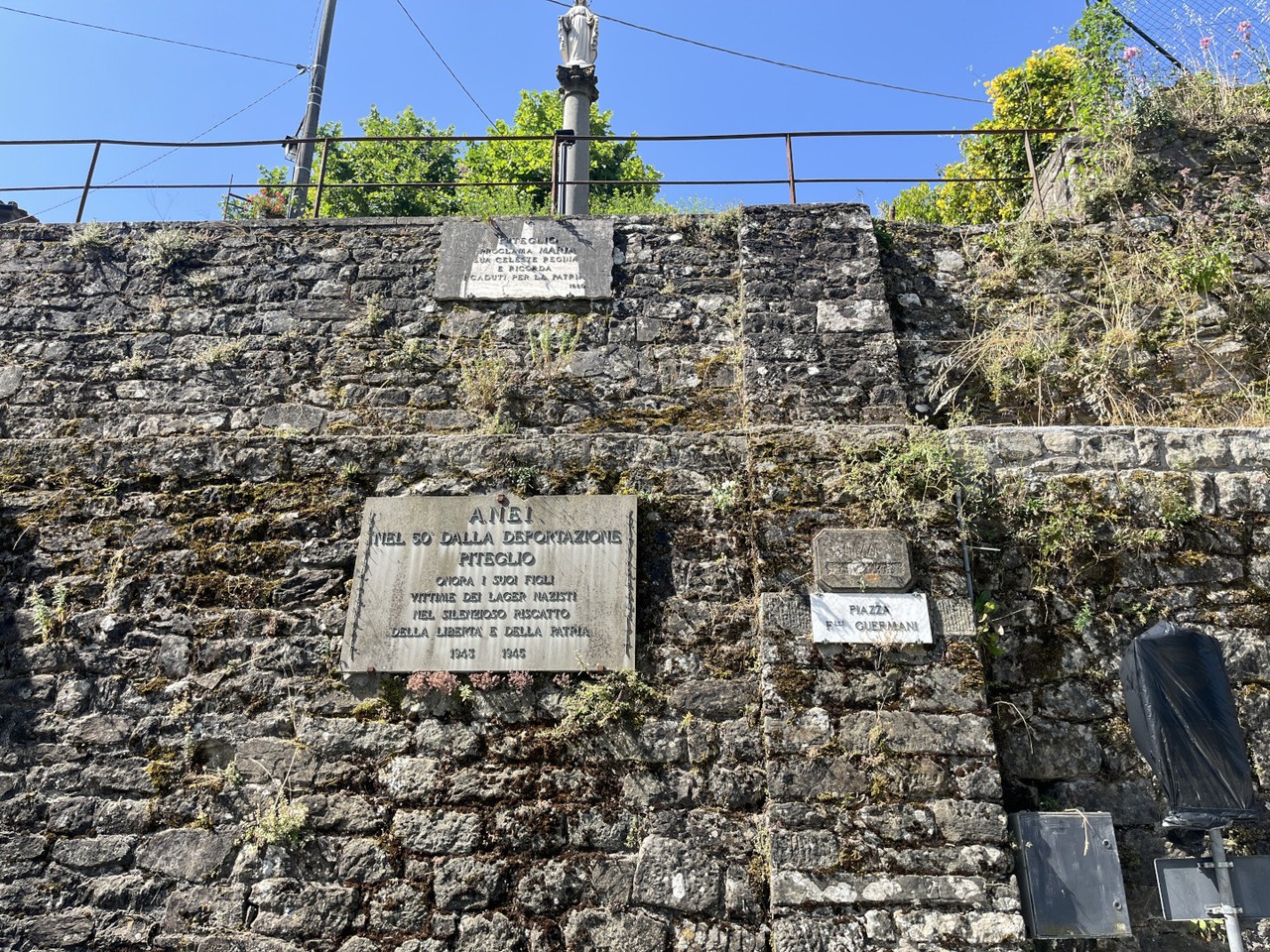
Ascending again from the valley, the route reaches Piteglio, one of the oldest villages in the Pistoia Mountains. The wide terrace in the center of the village welcomes the walker, opening toward the northwest in the direction of Abetone, offering a spectacular panorama. Here the cult of the Madonna del Latte is deeply rooted, preserved in the Church of Santa Maria Assunta atop the fortress, for centuries a stop for pilgrims crossing the Apennines. In Piazza Fratelli Guermani, a plaque installed in 1993 by the National Association of Former Internees commemorates the inhabitants of Piteglio deported and killed in Nazi camps.
Just outside the village, the route passes the “Pieve Vecchia,” an 11th-century place of worship linked to the presence of Matilda of Canossa, before reaching the locality of Migliorini, where the final path toward the stage destination begins. Prataccio is a hamlet at about 900 meters above sea level that historically based its economy not only on forestry and chestnut cultivation but also on ice production for food preservation. It sits on a natural terrace that embraces, in a single sweeping view, the peaks of the Tuscan-Emilian Apennines and the highlands of the Pistoia Mountains, inviting a well-earned pause and contemplation.