In this trail, the Italian journey returns to walking through forests, passing several small villages ready to surprise visitors with monumental trees, legendary heroes, and fantastical creatures, with the opportunity to descend into cool, vegetation-rich canyons while listening for an ancient, secret language.
From the elegant and nostalgic atmosphere of Bagni di Lucca, the stage begins by climbing the Val di Lima toward the northeast, moving from thermal springs to wooded hills dotted with neoclassical villas. After passing through Guzzano, a small mid-slope settlement, the route reaches the vicinity of the Parish Church of Controne, a basilica-shaped Romanesque church that still preserves its original marble inlaid floor.
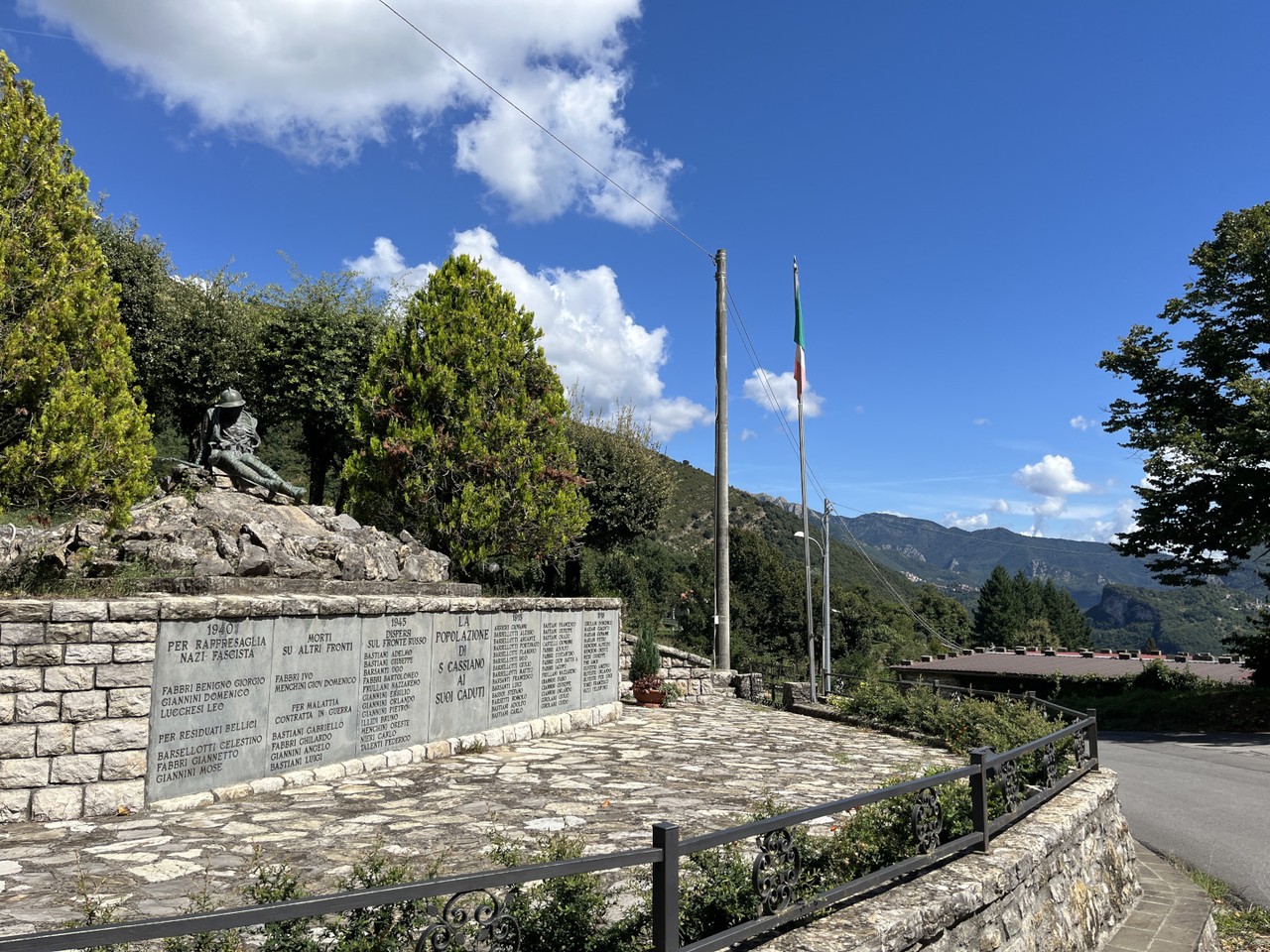
From here, the path touches the localities of San Gemignano and Vetteglia, then continues to San Cassiano, where the church dedicated to the saint stands out as a fascinating example of Lombard-era architecture, alongside the equally interesting parish museum. On the other side of the road is the Monument to the Fallen of the First and Second World Wars; after the Second World War, it was also dedicated to victims of Nazi-Fascist massacres and wartime unexploded ordnance. Leaving the village, one encounters a monumental tree, the Cocolaio chestnut, which grows at an altitude below 500 meters — a rarity, since the oldest specimens are usually found in colder, higher-altitude areas.
The climb continues to Palleggio, an ancient village mentioned in documents from the Archiepiscopal Archive of Lucca dating back to 983 and 991, though the toponym may derive from a Roman settler named Panuleius. The bell tower of the parish church of Santa Maria Assunta was built from an ancient medieval watchtower and now overlooks a mountain village that blends tranquility with rustic charm.
The trail continues along the wooded ridge until reaching Cocciglia, entered through the gate of Chiarello — the local hero — accessing the ancient medieval fortress, of which loopholes and small windows are still visible. A short detour down to the Lima River reveals the Ponte Nero and the Strette di Cocciglia: limestone gorges carved by centuries of river erosion, forming winding passages with whirlpools and eddies, where legend says the Dragon Regolo still dwells.
Leaving Cocciglia, the path climbs again toward Limano, “the silent one,” a small village dating back to around 800 AD, perched on a hill on the right side of the Lima valley, originally built to control the river that gave it its name. The route continues along the traces of the Cammino di San Bartolomeo, one of the spiritual paths crossing the valley, following ancient Lombard routes. The vegetation is dominated by vast monumental chestnut groves, mixed with beech and woodland where deer and roe deer find refuge.
The final destination is Vico Pancellorum, a “natural terrace” of ancient charm at 555 meters above sea level. The village’s parish church is a masterpiece of Lucchese Romanesque architecture, the oldest in the entire Val di Lima, with a portal carved with symbolic motifs that for centuries have been interpreted as an allegorical puzzle. Another distinctive feature of Vico is its historical craft tradition: its inhabitants were once tinsmiths, locally called arivari, who developed their own secret language known as “arivaresca” to avoid being understood during their trading journeys across central Italy, passed down through generations.